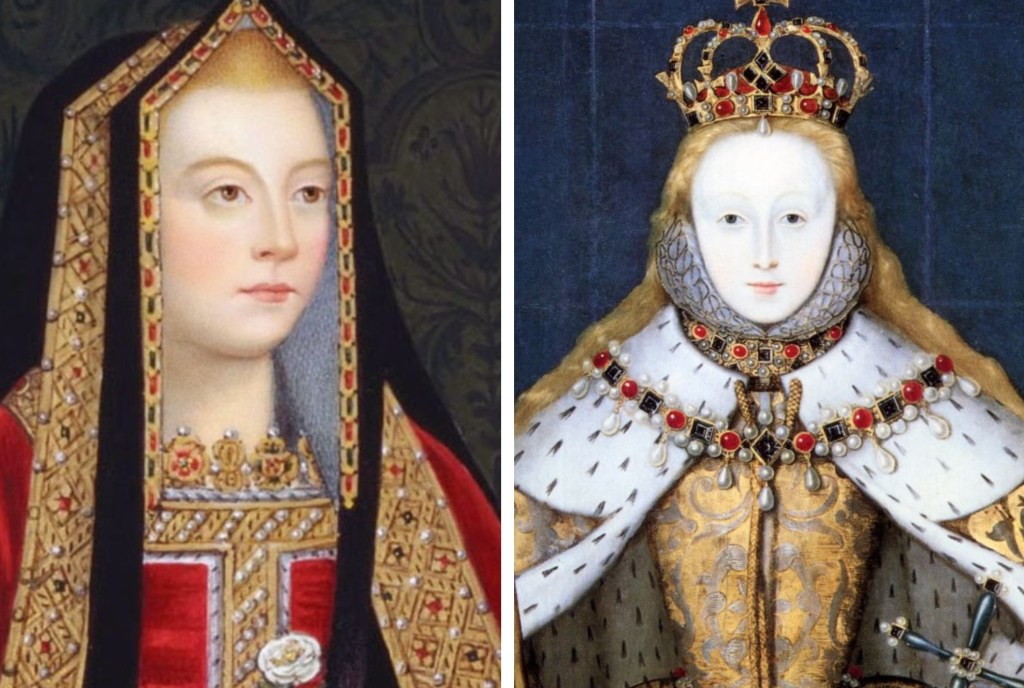
There is something extraordinarily symbolic in the story of Elizabeth of York and her niece, Elizabeth I. Two women, same name, same blood. One at the dawn, the other at the dusk of the Tudor dynasty. And exactly one hundred years lie between them.
Elizabeth of York died in 1503. Elizabeth I in 1603.
A full century. As if time itself had wanted to frame the Tudor reign between two women named Elizabeth… something not entirely unusual for our Elizabeth of York, who was born and died on the same day: February 11th.
Elizabeth of York was the link between the Houses of York and Lancaster. Her political marriage to Henry VII laid the foundation for the entire Tudor dynasty.
Seemingly gentle, yet central, she was the mother of Henry VIII and a symbol of peace after years of war. A symbol of sacrifice, meant to put an end to that trail of needless deaths.
Elizabeth I was her granddaughter, and she was the last Tudor monarch.
Childless, with no direct heirs, she brought an age to a close.

But she did so with clarity, passing the throne to James VI of Scotland, son of her cousin Mary Stuart and grandson of Margaret Tudor, another daughter of Elizabeth of York.
Elizabeth’s blood continued, but no longer under the Tudor name. Perhaps exactly as Elizabeth I wished. A name stained, above all, by the tyrannical rule of her father, Henry VIII, who had her mother executed and plunged the country into a series of conflicts Elizabeth would spend her life trying to contain.
Another thing that has always struck me about the two Elizabeths is their mottos—mottos that, it seems, continue to speak even when history falls silent.
As a young woman, Elizabeth of York chose “Sans removyr,” meaning: “Never changing, never forgetting.”
A phrase that speaks of melancholy, loyalty, and a wounded yet proud identity.
Elizabeth I adopted “Semper eadem,” the famous “Always the same.”
Not just a motto, but a manifesto: despite everything, I will remain myself.
Two women in different eras, yet with the same intent, to remain true to who they were. And perhaps, in that, they were more alike than one might think.
Elizabeth I never denied her York ancestry, nor did she ever deny the memory of her mother, whom she carried with her until her deathbed, wearing the legendary Chequers Ring, in which both women are depicted together inside the jewel.

The queen whom many called “the Virgin” never forgot her mother. Nor her grandmother. She never forgot where she came from.
It is, in fact, well known that in 1573, Elizabeth I visited Fotheringhay, and there she had a solemn commemorative sermon held in the surviving church.
The sermon was delivered by William Wickham, then her royal chaplain, who would later become Bishop of Winchester.
The tone of the sermon was commemorative and reverent, especially toward Richard Plantagenet, Duke of York, her great grandfather, described as a virtuous yet unfortunate man.
Elizabeth I sought to affirm the legitimacy of her lineage, emphasizing her Yorkist roots. Many have wondered whether Elizabeth I deliberately chose not to have children in order to end the Tudor dynasty.
Was it truly a biological impossibility? Or a conscious choice?
Perhaps she knew the Tudor line had been born in blood and compromise, and she felt it was no longer time to continue it, but to pass on the crown instead.
And so, the crown went to a “foreigner”, yet one bound by blood to her own lineage.
The Tudor cycle begins with one Elizabeth and ends with another.
Two women, distant in time, yet connected by far more than a name.
Perhaps it was destiny. Or perhaps, more simply, a wholly feminine choice: to begin, to let go, and to remember.
Without ever forgetting. Without ever changing. Ever faithful… always the same.
Like this? Support my work on Ko-fi and help me tell the stories no one else dares to: https://ko-fi.com/elizabethrasicci


 Beyond Death
Scrivi una risposta a James Elkington Cancella risposta