
If I said the word “godemiché” what would come to mind?
Wait, let’s take a step back.
In ancient Greece and ancient Rome, sexual satisfaction was considered a fundamental aspect of life. Even then, objects designed exclusively for female pleasure existed, often with purposes that were not even too subtly voyeuristic. In short, pleasure was everyone’s business, both men and women.
These instruments were called “olisboi” a term that literally means “to insert” (not much room for imagination, I’d say). They were artificial phalluses about 15 cm long, made of wood and covered in leather to make them softer.

So no, we haven’t invented anything groundbreaking. But let’s move on.
The word “godemiché” has French origins and means, quite simply, “make me enjoy.”
Do I really need to explain what it is, or have you already figured it out on your own?
Well, the godemiché is nothing more than a historical and elegant term for what we today call a dildo: an artificial phallus used for personal or couple’s pleasure.
The term probably originated in France in the 18th century and is linked to aristocratic and literary circles, where language was a refined art and licentious topics were discussed with elegance and irony. Not surprisingly, the godemiché appears in libertine texts and even in private diaries, proving that it was a known, widespread, and far from taboo object.
Then, the Catholic Church came along and ruined all the fun.
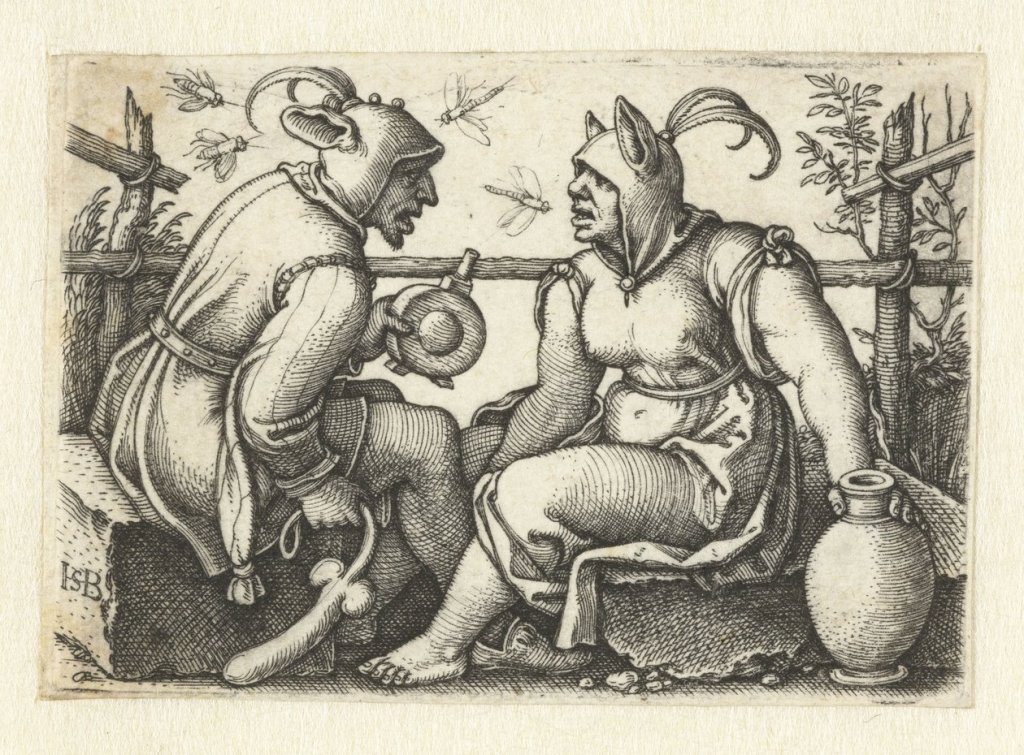
The “Fool” with the Phallus and the “Female Fool” by Sebald Beham
With its doctrine that sex should serve only for procreation, everything related to pleasure for its own sake was branded as sin. Masturbation? No, thank you. Desire? Better confess it. Impure urges? Mortify yourself and pray.
But let’s pause for a moment… how much of this is actually true?
And here begins the showdown: real life vs. religious hypocrisy.
Did people really abide by these prohibitions? And more importantly… did the Church follow its own rules?
Now, let’s be clear:
Only a fool believes that everything written in history books is true. Only a naïve person thinks people were so terrified of the Church that they blindly obeyed its dictates.
Only an idealist believes that human beings are not driven by impulses that go beyond imposed morality.
Because there is only one truth: we have always been human, in every era of history.
We have always felt hunger, sleep, and sexual desire. And no one, absolutely no one, was exempt.
Not even the most pious kings and the most devout queens. Not even the most religious monks and the most chaste nuns.
They got aroused, had lovers, fornicated freely, “sinned” with enthusiasm, fathered illegitimate children, felt attraction for those outside their marriage, and yes, they woke up aroused in the morning just like we do today.
This doesn’t mean they didn’t have sincere feelings for their partners, but sex is sex.
And confusing it with love is a mistake we still make today. Do I really need to explain that? Come on.
And the monks? Well, as pious and devout as they were, they too had to deal with this little problem of human nature.
And here we get to the point. The godemiché in monasteries? Yes, even there! Especially there!
The Middle Ages instilled in people the fear of pleasure, but it certainly didn’t curb their impulses. On the contrary, it made them more secretive, more twisted, more unrestrained.
If we had lived in the Middle Ages, we probably would have found a godemiché hidden within the walls of a monastery (both male and female ones!).
And no, they weren’t that different from the ones we know today.
Some were hollow and had a cork stopper, others were filled with warm water to make them more comfortable (because, let’s be honest, no one likes the cold).
So we can say, with absolute certainty, that history has never been chaste.
As fascinating as the idea of a Middle Ages filled with pure knights, devoted princesses, marital fidelity, and fear of God may be, the reality is quite different.
The truth is that they had fun. Everyone. The poor, the rich, kings, queens, monks, and nuns.
Because human beings can change their clothes, speak different languages, listen to different music…
But impulses, those, will always remain the same.
In any era and in any place.
Like this? Support my work on Ko-fi and help me tell the stories no one else dares to: https://ko-fi.com/elizabethrasicci


 Beyond Death
Scrivi una risposta a Elisabetta Rasicci Cancella risposta