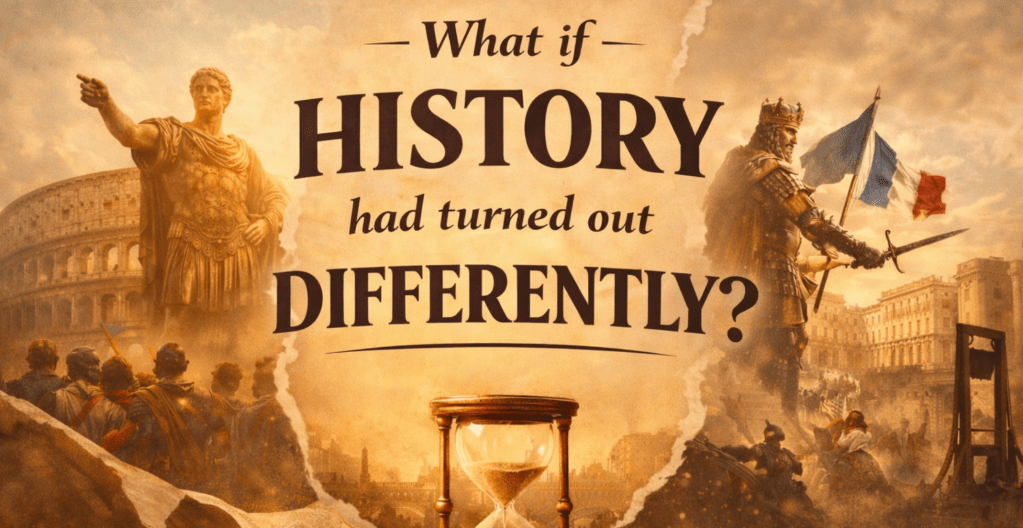
I’ve always had a problem with myself, and with everything around me. I can never stop wondering how things might have turned out if they had taken a different direction from the one they actually did.
To be clear, it’s not like I spend every day, every hour, imagining all the different ways my life, or the lives of the people around me, could unfold… but I do find myself asking how history, the one we know, might have gone if certain major events had never happened, or had happened differently.
The technical term for this kind of thinking is uchronia: historical uchronia is what has allowed great thinkers and writers to give birth to their ideas and pour them onto paper, turning them into reflection.
And this, perhaps, over the course of my life, has shaped me to the point that I now find myself here, asking exactly the same question.
(Though, if this had never happened in my life, I’d probably just be making TikTok videos or writing about football… who knows.)
History is not inevitable… just as our lives and the times we live in are not inevitable.
Sometimes it takes very little. A moment of hesitation. A decision made, or not made. A gesture that never comes. And everything, truly everything, takes a different direction.
There are moments when history tilts and hangs there, suspended for an instant, before falling to one side. But it could have fallen the other way. (Hey… remember Match Point by Woody Allen? Well… tadaaaan!)
These past few days I’ve been thinking about three major events that have scrambled my mind so much that I’m now here, writing about them, trying to make sense of them, or at least to get them out of my head and set myself free.
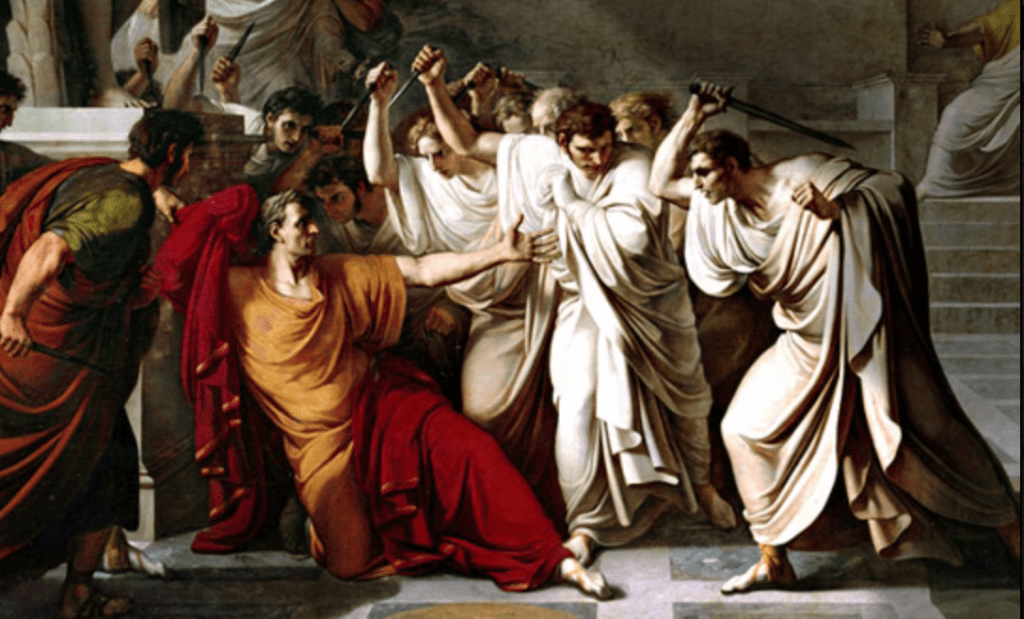
What if Julius Caesar had not been assassinated on that 15th of March?
We are in Rome. It is March 15, 44 BC.
Caesar enters the Senate. The tension is palpable, yet invisible. The conspirators are there, ready. They’ve decided, everything has been planned down to the smallest detail, and yet… something cracks.
A doubt. A doubt that turns into fear. A glance that becomes a chain of exchanged looks. The sudden awareness that they are about to commit an irreversible act, and that perhaps no one will find the courage to strike the first blow.
And so that initial courage dissolves into fear, a fear that paralyzes everything. The dagger remains still, gripped tightly in their hands, hidden beneath the senators’ togas.
Caesar stands there, in their midst. He senses no broken breath, no quickened heartbeat. He cannot imagine that those men are holding the weapon that would have prevented him from seeing the next dawn. He simply cannot imagine it.
And so he begins to speak. He moves back and forth, gestures, smiles. He points at something he disapproves of… then leaves the Senate… alive.
There is no blood on the floor. No final blow struck by an ungrateful adopted son.
March 15 does not become a symbolic date. The Ides of March are just another day, destined to end with the usual banquets, rich with food and wine.
That evening, Caesar would celebrate with his family and his most loyal allies. And this would change everything.
The next day, the future Caesar was already envisioning would begin to take shape. The expedition against Parthia would become reality—not just a military campaign, but a personal revenge, a way to finally close the circle opened by the death of Marcus Licinius Crassus.
A victory there would have cemented his power definitively, effectively transforming him into a ruler, even without ever declaring himself one.
Without his death, there would have been no room for chaos. No civil war, no irreparable fracture. Power would have followed a clearer, more controlled path. At his side, Augustus would have grown not as an avenger, but as an heir. No longer a struggle between men, but a continuity built with clarity and intent.
Meanwhile, in Rome, his reforms would have continued to slowly erode what remained of the Republic. No sudden rupture, no need for proclamations, just a gradual shift of power, until what no one yet dared to name became inevitable: a monarchy.
And then there was Cleopatra.
His bond with her would not have been broken. On the contrary, with Caesarion acting as a bridge between two worlds, the risk, or perhaps the destiny, would have been to see Rome shift its center elsewhere. Toward Egypt. Toward the East. Toward something completely different from what we know today.
But now, let’s leave Rome and move to England. Let’s take a leap through time and arrive on August 22, 1485, on the battlefield of Bosworth.
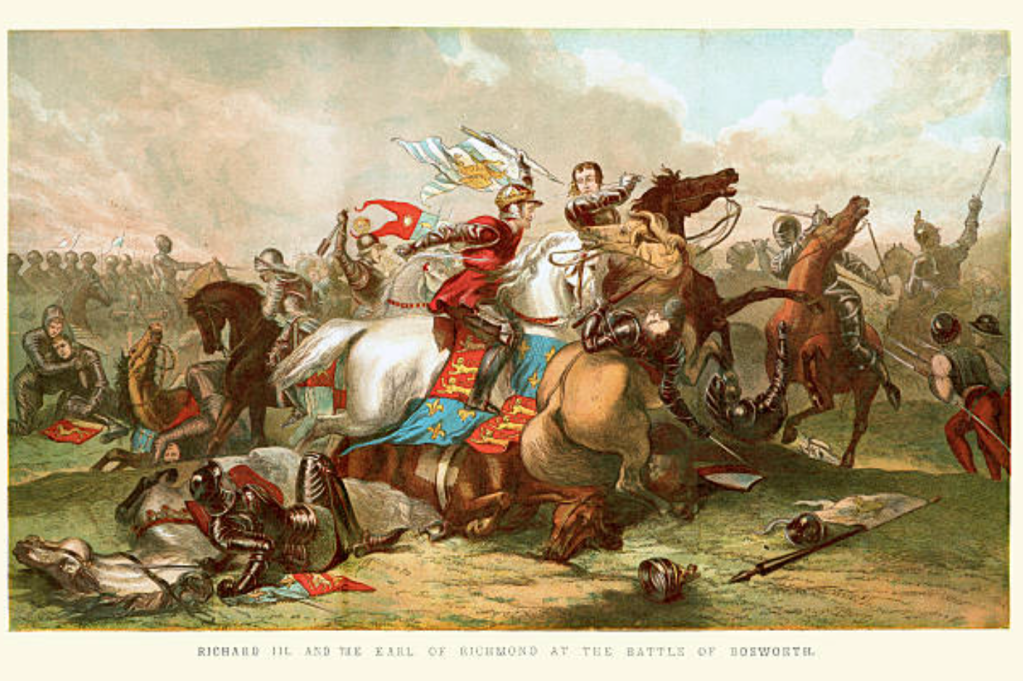
What if Richard III of England had won?
Richard III is challenged by the pretender Henry VII of England.
But that morning, the king is neither betrayed nor slaughtered on the field.
His allies choose to remain loyal. The battle ends after a few hours with a crushing victory for Richard, who remains King of England and forever cuts off the stem of the Tudor red rose.
August 22, 1485 marks, in the history books, the end of the English Middle Ages and the beginning of the Renaissance. Richard’s victory would have pushed that boundary forward.
After Bosworth, Richard would most likely have married one of the following: the Infanta of Spain, Joanna of Portugal, or Kunigunde of Austria.
And here, realistically, the most plausible choice is precisely the least well-known: Kunigunde.
Kunigunde was the sister of the Holy Roman Emperor, Maximilian I, Holy Roman Emperor. A strong bond already existed between him and Richard, not least because Richard’s sister, Margaret, was Maximilian’s step-aunt. Relations between England and the Empire were therefore already extremely solid.
Kunigunde was nineteen, an ideal age to quickly secure an heir, unlike the Infanta of Spain, who was too young, and Joanna, who was already considered too old for the time.
This would have consolidated the throne and created a powerful political axis between England, the Holy Roman Empire, and the Papacy.
And the consequences would have been enormous: the long rivalry between France and England might have come to an end, isolating France and greatly strengthening England, laying the groundwork for what could be seen as an early embryo of what we now call Europe.
And above all: no Tudors.
No Henry VIII of England, no Anne Boleyn, no Elizabeth I of England, no Mary, Queen of Scots, no James VI and I.
Different names. Different faces. A different history.
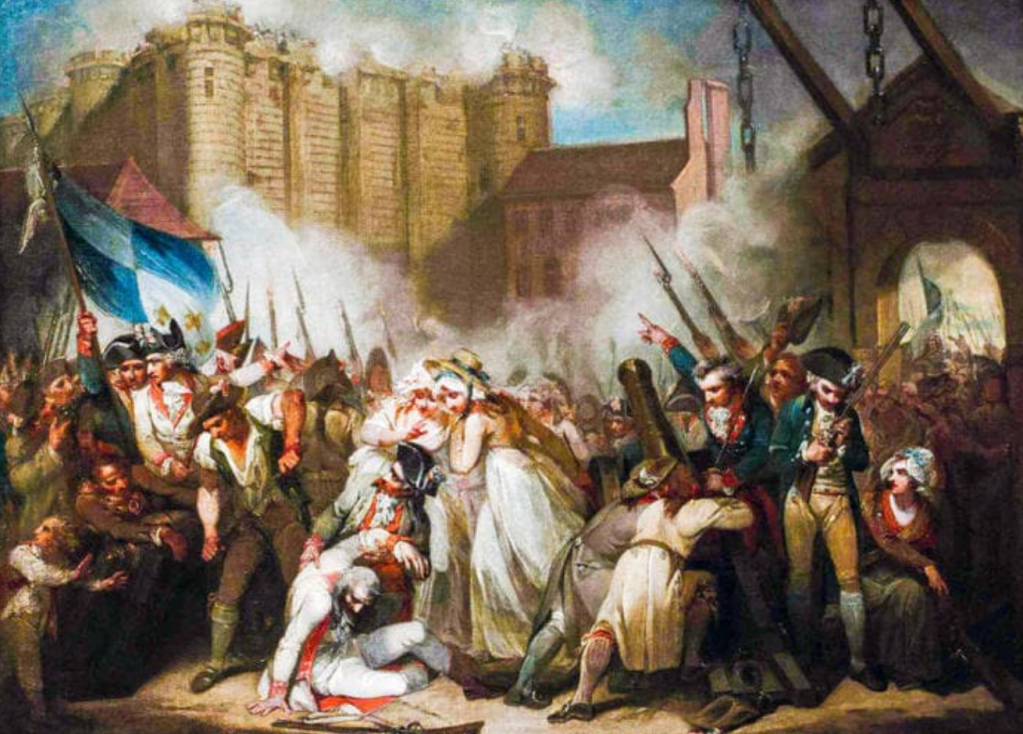
And finally, let’s take one last leap and arrive in Paris, 1789.
What if the French Revolution had never broken out?
The people are starving, it’s true… the news reaches Versailles dramatically… Marie Antoinette discovers it purely by chance through one of her ladies-in-waiting…
History tells us that when Marie Antoinette learned of the conditions in which the people were living, she burst into the king’s council chamber without knocking and demanded that something be done… and, above all, that she and the king be informed about the situation in Paris. Many of the cardinals present urged her to calm down and convinced her that the situation was under control, and that much of what she had heard was false… exaggerated.
They prevented her from remaining there with her husband, Louis XVI, because the main aim of the king’s “advisers” was simply to siphon as much money as possible from the royal treasury for their own personal gain… certainly not for the good of the country.
But imagine what would have happened if, that day, Marie Antoinette had stood her ground, if she had refused to leave that room, forcing them all to open the account books in front of her, until she realized that each and every one of them, herself included, had done nothing but strike the French people, reducing them to ruin.
Most likely, the two sovereigns would have carried out an internal reform, like the most effective coups, removing all the corrupt advisers and replacing them with more trustworthy ones.
They might have begun distributing bread and flour to the people, and the fury of Maximilien Robespierre would have subsided before long, because the kingdom had finally recognized the damage and was taking action.
There would have been no French Revolution… no guillotine (or at least not at that moment. By the way, did you know it was Louis XVI himself who suggested that the blade be angled rather than straight, to make the beheading more efficient? Yes, he took part in the design of the guillotine without knowing he would become one of its victims), no massacres… no Reign of Terror…
And what about Napoleon Bonaparte? What would have happened to him… the man who rose from the ashes of the Revolution to become what we know today?
Well, most likely that brilliant and ambitious officer would have had to wait a little longer before making his move… and who knows, who knows whether he would ever have ended up losing at Waterloo.
And you?
Are there other moments in history that, in your opinion, could have changed everything if things had only gone a different way?
P.S. I recommend reading Moments of Destiny by Stefan Zweig if this topic particularly intrigues you.
 Beyond Death
Lascia un commento