You probably think that swearing is a modern invention. That profanity belongs to us, the enlightened, irreverent present, and that in the Middle Ages, for instance, not only was it impossible, but it was actually quite likely that God would strike you down from the sky and set you on fire. Well, no.
In the Middle Ages (and of course in earlier periods as well), people swore, very much so. And the “real” swear word wasn’t sexual… it was religious.
Invoking “the blood of Christ,” “God’s bones,” or “the body of Our Lord” in a blasphemous way was not simply an expression of anger. It was perceived as a real act, almost physical. In a society founded on the concrete presence of the sacred, from the Eucharist to solemn oaths, verbally striking the body of God meant undermining the very order of the world.
In Florence, in the municipal statutes of the 14th and 15th centuries, blasphemy was punished with escalating fines; repeat offenders could end up in the pillory. In 15th-century Venice, the Council of Ten intervened repeatedly against those who “blasphemed the name of God and the saints.” In Bologna and Perugia, specific magistracies were appointed to repress “evil speech against God.”
Here, profanity was not merely an outburst, it was a crime. To insult someone meant challenging their position in the world, before men and before God. It was not a matter of sensitivity; it was a matter of social order. Technically, it still is today, but we rarely care.
And what about “dirty” swear words? They certainly existed.
In the 14th century, in the novellas of Boccaccio’s Decameron, the body is described without hypocrisy: sex, adultery, desire, deception. The vocabulary can be direct, even blunt, but it is not perceived as scandalous in the modern sense. The sharp divide between obscene language and moral condemnation, later reinforced in the post-Tridentine world, does not yet exist.
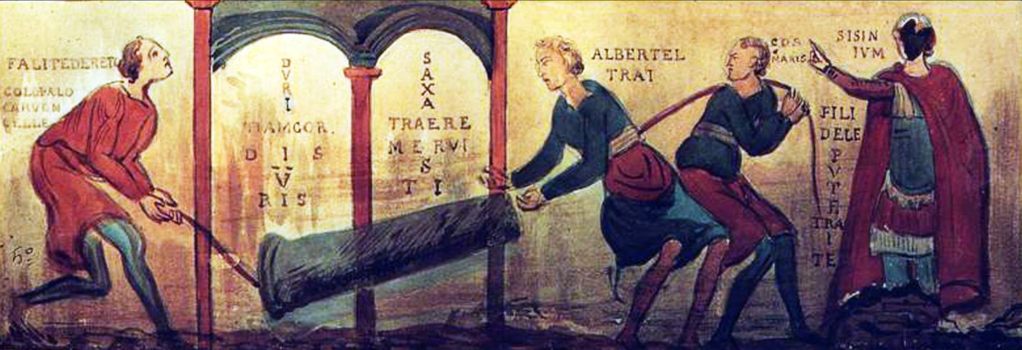
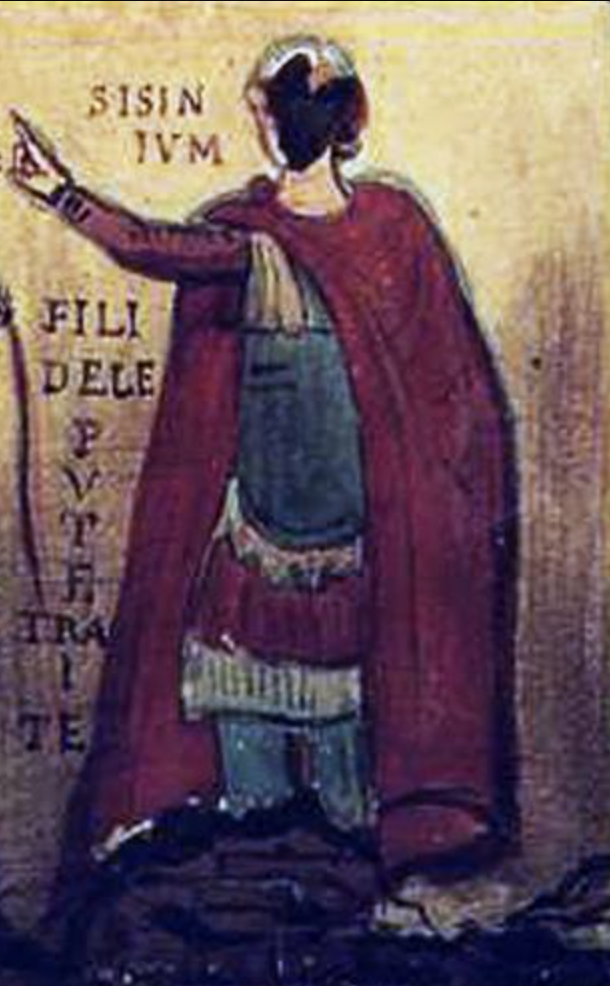
“Pull, you sons of bitches!”, Sisinnius, who certainly doesn’t mince his words, in a fresco in the Basilica of San Clemente in Rome.
If we move to England, written sources confirm that many words considered “modern” are in fact medieval. “Fuck” appears in recognizable form in a 15th-century satirical poem, often cited as Flen, flyys, where it is Latinized. “Cunt” is attested as early as the 13th century in toponymic records.
In London there really was a street called Gropecunt Lane, mentioned in city records of the 13th and 14th centuries. It was an area associated with prostitution. The term was vulgar, certainly, but it did not yet carry the absolute taboo weight it would acquire in the Victorian era. It was part of urban vocabulary.
France presents a similar picture: “merde” is already attested in 12th-century literary texts; “con” derives from the Latin cunnus and runs uninterrupted through the Middle Ages. Obscene vocabulary grew from the body and from everyday materiality, animals, excrement, sexuality, without the later veneer of moral hypocrisy.
And yet, paradoxically, the most dangerous insult was not the one that evoked sex, but the one that touched identity.
Calling someone a “bastard” unjustly meant contesting their legal legitimacy. Accusing someone of heresy could bring them before an ecclesiastical court. Calling someone a “usurer” or a “sodomite” was not merely an insult, it was an accusation with concrete consequences.
Medieval words were not only expressive; in certain cases they were performative. When they touched legitimacy or identity, they produced real legal and social effects.
Today, profanity is almost always an emotional release. In the Middle Ages, it was also a public act.
Now imagine taking to court everyone who calls you a “son of a bitch.”
 Beyond Death
Lascia un commento