
When we think of Christmas, we most often think of the tree, Santa Claus, lights, and huge family tables filled with laughter and arguments (yes, that happens too, let’s admit it peacefully!).
But in the Middle Ages, how was Christmas experienced?
First of all, Christmas festivities did not begin on December 8 as they do today. They started on December 25 and ended on Epiphany. They lasted twelve days and culminated in Twelfth Night, the Night of the Kings. It is within this context that the tradition of the King Cake was born and spread in England.
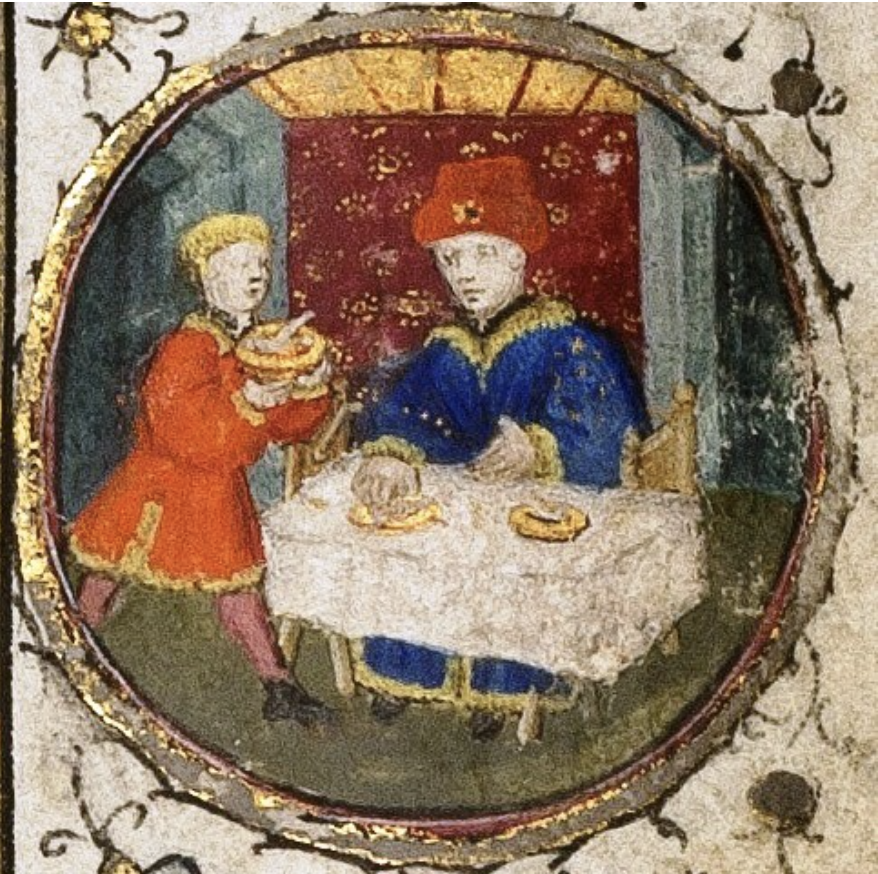
The King Cake was a simple dessert, yet one rich in symbolic meaning. It did not yet have the buttery richness or decorative refinement of modern versions: it was often a sweet bread or a rustic cake, enriched with spices, dried fruit, or honey, precious and festive ingredients. Inside it, an object was hidden, at first a dried bean, later a coin or a small token, which turned the act of cutting the cake into a ritual.
Whoever found the bean became the “King of the Day” (and the Queen). For twenty-four hours, they could give orders, choose games, impose playful penalties, and overturn hierarchies. A servant could become king; a young apprentice could give orders to his master. It was a game, of course, but also something deeper: a social safety valve, a ritual way of exorcising power, reminding everyone that all authority is temporary and that the world, at least for one night, can be turned upside down without breaking apart.
This tradition had ancient roots, reaching back to the Roman Saturnalia, but in the Middle Ages it was reshaped in a Christian key. The “king” of the cake was not merely a burlesque figure: he also evoked the Three Magi and the idea that the divine could manifest itself through humility, chance, and the unexpected.
The King Cake thus became a liminal object, suspended between sacred and profane, order and chaos, seriousness and play. It was not merely a Christmas dessert, but a small symbolic theatre in which a deeply medieval truth was staged: the world is unstable, power passes from hand to hand, and even the king, the real one, is in the end, a man destined to lose his crown.
It seems that the rumours claiming Richard III wished to marry his niece, Elizabeth of York, arose precisely because of a King Cake. It is said that during one such celebration Richard drew a bean (and thus remained king), while Elizabeth drew the other and became queen for a day. This sparked the vivid imagination of the clerics present, who, frowning upon the scene, hastily assumed that the king intended to marry the young and beautiful Elizabeth. But reality was quite different. Even if the two enjoyed themselves that day according to custom, the real situation was far more serious: Richard was facing a war that was already looming, and a family situation that was nothing short of disastrous.
This tradition was greatly loved, and perhaps this is why it has endured through the centuries. For beneath the sugar and spices it preserves an ancient and uncomfortable idea: that every kingdom is temporary, and that Christmas, more than any other moment, reminds us how fragile, and precious, the illusion of order truly is.
 Beyond Death
Lascia un commento