
In collective memory, the name of Cesare Borgia evokes intrigue, crimes, and cruelty. The “black legend” of the Borgias painted him as a Renaissance monster—fascinating and dangerous, capable of killing brothers and betraying allies without remorse. Yet behind this mask of blood and fear lies a cultured, refined man, a talented strategist and visionary politician, who was perhaps more a victim of propaganda than of his own actions.
Born in Subiaco in 1475, the son of Rodrigo Borgia (the future Pope Alexander VI) and Vannozza Cattanei, Cesare seemed destined for an ecclesiastical career. At just eighteen he was appointed cardinal—a meteoric rise that promised his family power and prestige within the Roman Curia.
But his nature was very different: Cesare was not made for the shadows of ecclesiastical palaces, but for action. The violent death of his brother Giovanni, Duke of Gandia, drove him to an unprecedented step: he abandoned the cardinal’s robes to take up the sword. He became Duke of Valentinois, a title granted by the King of France, Louis XII, and married Charlotte d’Albret, sister of the King of Navarre.
In a short time, Cesare transformed from prince of the Church into an ambitious warlord, with a network of international alliances that made European courts tremble.
Contrary to the image of a brutal soldier, Cesare was a profoundly cultured man. He spoke several languages, loved music, the arts, and literature. He was elegant in bearing and dress, and his court, rich with artists and intellectuals, reflected the taste and splendor of the Renaissance. Chronicles describe him as a man capable of captivating anyone he met, endowed with natural charisma and uncommon intelligence.
But his ambitions did not stop at the dynastic survival of the Borgias. Cesare grasped a truth that many would understand only centuries later: a divided Italy was weak, vulnerable to foreign powers. His goal was to build a strong, central state that could become the nucleus of a future unification.
His military campaigns were as ruthless as they were brilliant. He conquered and pacified Romagna, subduing rebellious cities such as Imola, Forlì, and Rimini. He imposed order in lands torn apart by decades of feuds and anarchy. In this, Cesare was not only a warrior but also a modern administrator.
Niccolò Machiavelli met Cesare in person and was fascinated by him. In The Prince he presented him as the model of the ideal ruler: ruthless when necessary, but farsighted, capable of laying the foundations of a stable state. For Machiavelli, Cesare had everything a great leader needed—except fortune. The death of his father, Pope Alexander VI, and the sudden shift in alliances left him isolated, without political support.
Around Cesare also lingers the legend of his relationship with his sister Lucrezia, surrounded by rumors of incest and scandal. In reality, historical sources tell a different story: Cesare used Lucrezia’s marriages as political tools, but at the same time he protected her and maintained a sincere bond with her. Their letters, full of fraternal affection, reveal a relationship very different from the dark myth handed down by their enemies.
Cesare’s dream collapsed with his father’s death in 1503 and the election to the papacy of Julius II, a fierce enemy of the Borgias. Stricken with syphilis, weakened and isolated, Cesare was arrested, imprisoned in Spain, and eventually released.
He then sought refuge in Navarre, with the family of his wife, Charlotte d’Albret, sister of the king. There he put his military skills at the service of his brother-in-law, engaged in defending his domains against rebellious lords.
It was during one of these campaigns that Cesare met his end: in 1507, near Viana, he fell in battle against the rebel troops of the Count of Lerín. Betrayed by a maneuver, separated from his men and surrounded by enemies, he was killed after a final desperate fight.
Cesare was only thirty-one years old.
His body was buried in the Church of Santa Maria of Viana, but his presence there was never welcomed: a man like him, once a cardinal and feared warlord, was deemed unworthy of resting in consecrated ground. Over the centuries, his tomb was repeatedly desecrated, moved, and even thrown outside the church. For a long time, his bones lay in the town’s main street, trampled by passersby and religious processions, as a moral warning.
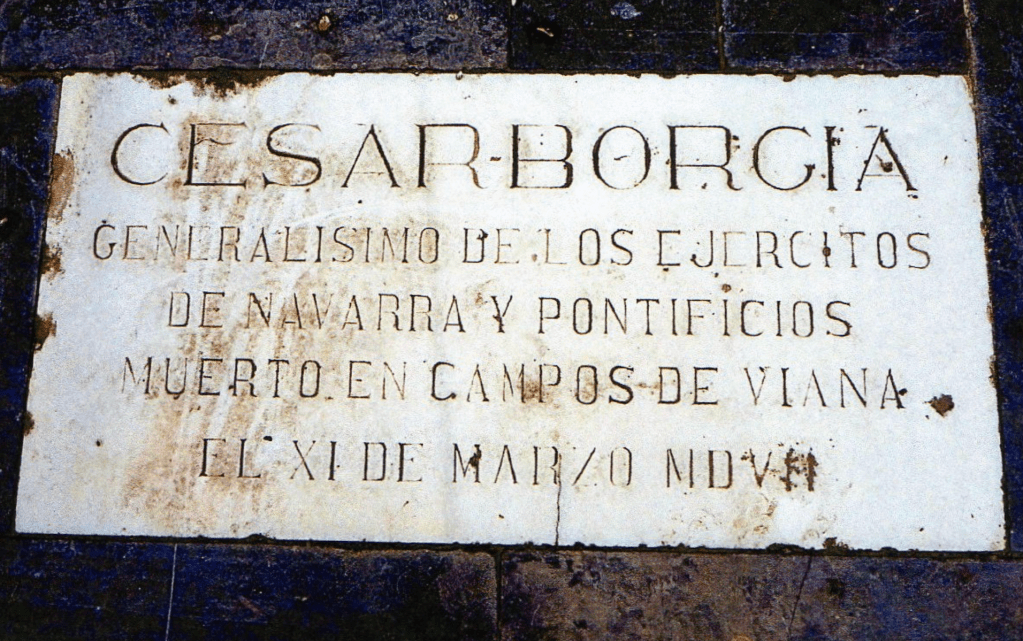
Only in the twentieth century were his remains placed back inside the church, where they still rest today. His tomb once bore an inscription that reads almost like a challenge:
“Here lies in little earth he whom all feared, he who held peace and war in his hand, he whom Fortune raised and then cast down, he who with arms and with mind subdued the world.”
Today this inscription is no longer visible: we know it only thanks to the historical accounts that have preserved it.
Cesare Borgia was not the demonic monster spread by propaganda. He was a man of his time: ruthless when circumstances required it, but also cultured, visionary, and capable of seeing further than many others.
His political project failed, but a fascinating question remains: if fortune had not abandoned him, could he have truly become the first Prince of Italy?
 Beyond Death
Lascia un commento