“Treason! Treason!”
These were the last words of Richard III on the battlefield of Bosworth, just before a blow struck him from behind, ending his life at only 32 years of age.
In recent weeks I have deliberately chosen not to post anything, as my mind has remained fixed on an event deeply rooted in time and in the pages of history.
The Battle of Bosworth was fought on 22 August 1485, marking not only the death of King Richard III on the battlefield but also the end of the English Middle Ages.
From that day on, the Tudor dynasty ruled for about a century, and the English Renaissance began.
It was ten o’clock in the morning when it was all over: Richard lay dead on the ground, and Henry Tudor placed the blood-stained crown upon his head.
But let us take a step back.
It is said that on the night between 21 and 22 August Richard barely slept. Tudor propaganda claimed this was due to the weight of his countless sins and demons, but the truth is far simpler: a man preparing for battle knows full well he may not live to see another dawn. Who could sleep peacefully with such knowledge?
The royal army was likely encamped around Sutton Cheney. At the same time, Henry Tudor was at Merevale, where he is thought to have held a secret meeting with William Stanley before dawn. (Traitors, before betraying, speak among themselves and plan the most convenient moment. Nothing is left to chance.)
Richard awoke at dawn, around six o’clock, and Mass was probably celebrated in the camp, inside a tent, using a portable altar. (The famous Bosworth Cross, now preserved at the Society of Antiquaries in London, stands as proof of this.)
There were delays in the celebration of Mass, but it was eventually held around 6:40. Richard, in all likelihood, wore a red chasuble in honour of the martyrs.
Then, at about 7:10, the service ended and the king had a light breakfast of bread and wine, as was customary at the time, while his squires began helping him into his armour.
Between 7:30 and 7:40, the chaplains dismantled the altar and prepared the Bosworth Crucifix as a processional cross for the march. Richard wore a golden open crown over his helmet and stepped out of the tent to bless his troops.
Ten minutes before eight, the royal army took position on a low rise to the northwest of Crown Hill, and at eight o’clock Henry Tudor’s forces began to advance, skirting the marshy ground.
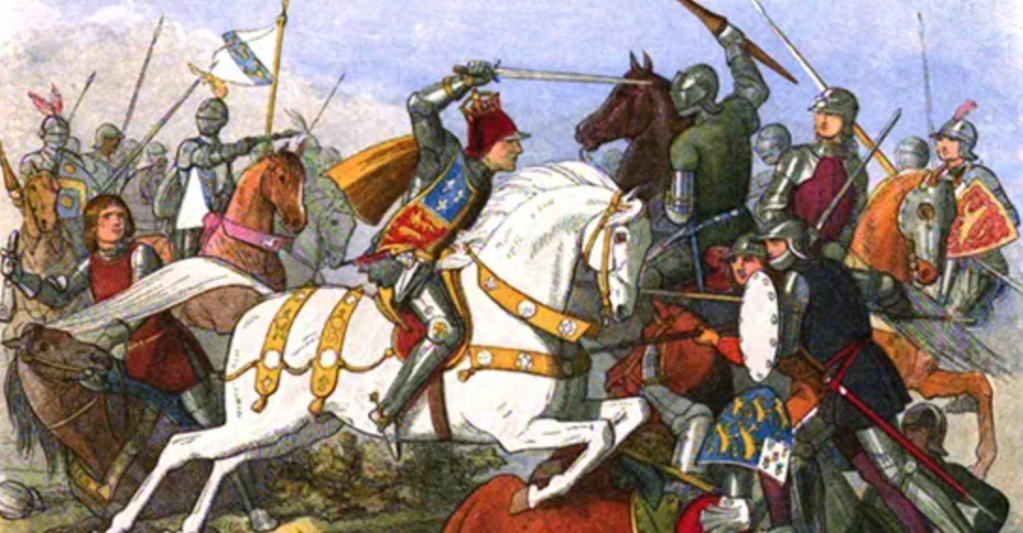
Around 8:30, Richard spotted Henry on the field and decided to charge personally in an attempt to kill him in a swift and daring action.
Many have interpreted this as a desperate gesture, the result of depression or of a fever that may have struck him a few days before the battle. In reality, his actions were perfectly in line with the chivalric codes of the time. It seems that Richard had chosen to challenge Henry Tudor to single combat in order to avoid further bloodshed, but he was literally lured into a trap.
He charged alone, on horseback, and in one single blow struck down Sir William Brandon, Tudor’s standard-bearer, bringing down the enemy banner. Henry stood protected behind him, and when Richard was only a few steps away, ready to strike and end the battle, Tudor’s foreign mercenaries formed a square of pikemen, shielding him and blocking the advance of the royal cavalry.
At that moment, Lord Stanley intervened in Henry’s favour, betraying his king and attacking Richard from the flank. The king’s horse was killed and he fell, losing his helmet. He was struck on the head; the final blow, delivered from behind, pierced the unprotected base of his skull and was fatal.
“Treason! Treason!” were his last words, and at ten o’clock in the morning of 22 August 1485 the battle was over. The royal army, left without a commander, scattered. Richard III was only thirty-two years old and had reigned for just over two years.
According to Polydore Vergil, who served Tudor propaganda, Richard died “fighting manfully in the thickest press of his enemies”… and on this, not even his detractors can disagree.
What happened afterwards is history. A history the Tudors tried to erase, but which has returned with force thanks to the discovery of Richard’s skeleton.
Henry Tudor had himself crowned on the battlefield, among the corpses of soldiers and the body of the king, wearing the crown that Richard had borne upon his helmet. Thus began his reign, wearing a crown that was not his own, steeped in another man’s blood.
Richard’s battered body was dragged from among the dead, stripped completely naked and thrown face down across a horse. During the transport they continued to abuse him, striking his back and buttocks repeatedly, and so he entered Leicester, to the horrified gaze of its inhabitants.
His naked body was displayed for two days at Newark, and only afterwards, under pressure from the Grey Friars, was he hastily buried without honours on 25 August 1485.
For more than five centuries Richard rested in a grave too small for him, without clothing and without a coffin. In the bare earth that held him like a mother cradles her child in her arms, and so it has returned him to us.
On 25 August 2012, exactly five centuries after his burial, Richard came back to light: his skeleton was found in a car park in Leicester, on the very site where the Greyfriars’ monastery once stood. There it had survived the passing of centuries, untouched by construction, demolition, and the destruction of the churches after Henry VIII’s schism.
He endured for five centuries so that we might all see what had been done to him.
Richard’s skeleton revealed the body of a man literally massacred by his enemies: struck repeatedly, mostly from behind and from the side, surrounded and finished off by a blow to the back of the head that tore away part of his skull and exposed the brain. Yet Tudor, not content with this, allowed the body to be further desecrated even after death.
He stripped him, abused him, dragged him naked to Leicester and displayed him so, deprived not only of life but of dignity.
He had him buried in a miserable grave, and smeared his memory, crafting the monster that would justify the seizure of a throne that was not his.
Henry Tudor’s claim to the throne was weak, tainted on both his mother’s and father’s side. He was the product of a series of events fortunate for him and disastrous for Richard.
His hatred of the House of York did not end with Richard’s murder, it has endured through the centuries.
He made sure that everything good Richard had done was destroyed, and that he would be remembered as a usurper, a murderer, an infanticide, ugly and deformed.
He destroyed documents and memory, but he could not destroy the man himself. After five centuries, Richard has risen from his grave to demand justice.
Today we know exactly what Tudor did: he literally tore the crown from Richard’s head and laboured to annihilate his memory. But he did not succeed.
Richard is returning to the light for what he truly was: a man, a knight, a king who embraced his destiny to the very end, with courage, even as life and traitors conspired against him.
What Henry Tudor did was not justice. It was theft, murder, and desecration, of bodies and of memory.
It is time the books told the truth. It is time to say that Shakespeare’s Richard III is a work of fiction, financed by propaganda. It is time that schools teach the true story, ceasing to lend support to lies.
It is time that everyone knows who King Richard III was, and what 22 August 1485 really represents.
Now, always and forever, Loyaulte me lie.
Elizabeth
 Beyond Death
Lascia un commento