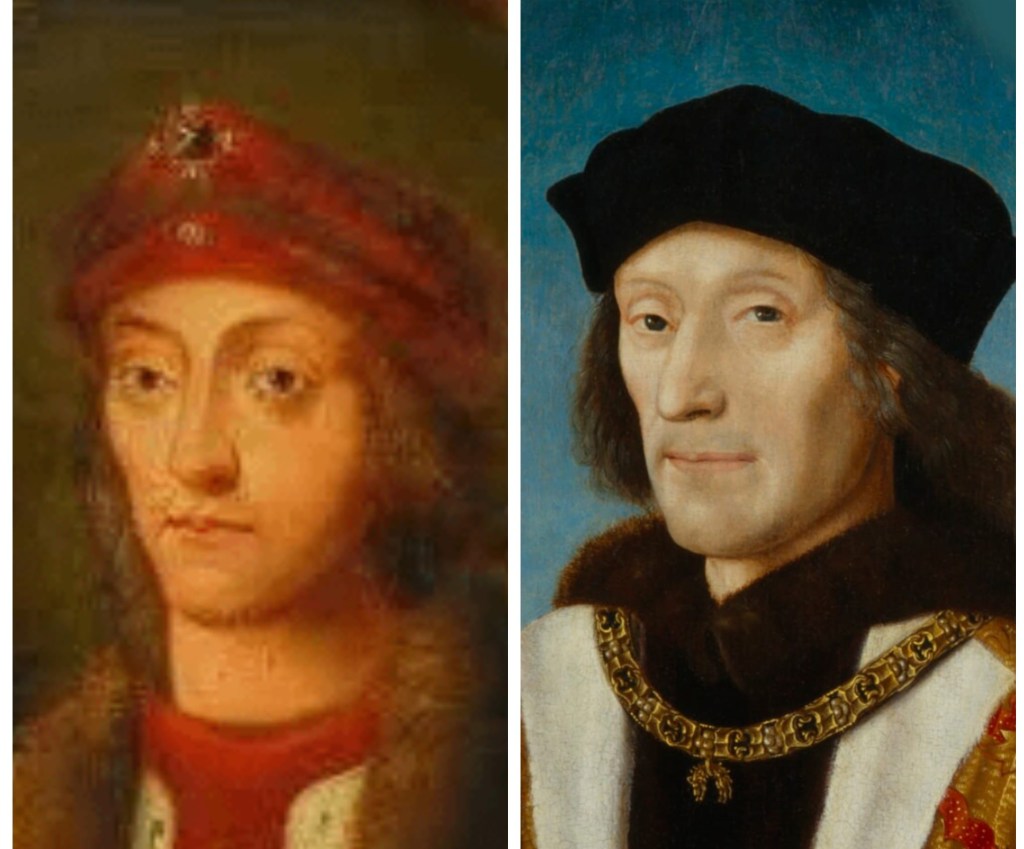
Once upon a time, there was a child, born around 1474 in Brittany, who, after the assassination of Richard III at Bosworth, lived at the court of the new king, Henry VII, as a trusted knight of the Tudors. He died in 1535, leaving behind a trail of whispers that still echo today: who was Roland de Velville?
We are in the Brittany of Duke Francis II. Henry Tudor, still young and without a title, lived in exile, closely watched and with little hope for the future. It is in this context that a relationship is believed to have developed between him and a Breton noblewoman, possibly connected to the Counts of Durtal, near Nantes.
From their union, Roland may have been born, raised far from the spotlight, yet always close to power.
Roland may have arrived in England as early as 1485, the year Henry claimed the crown. He would have been only ten or eleven years old.
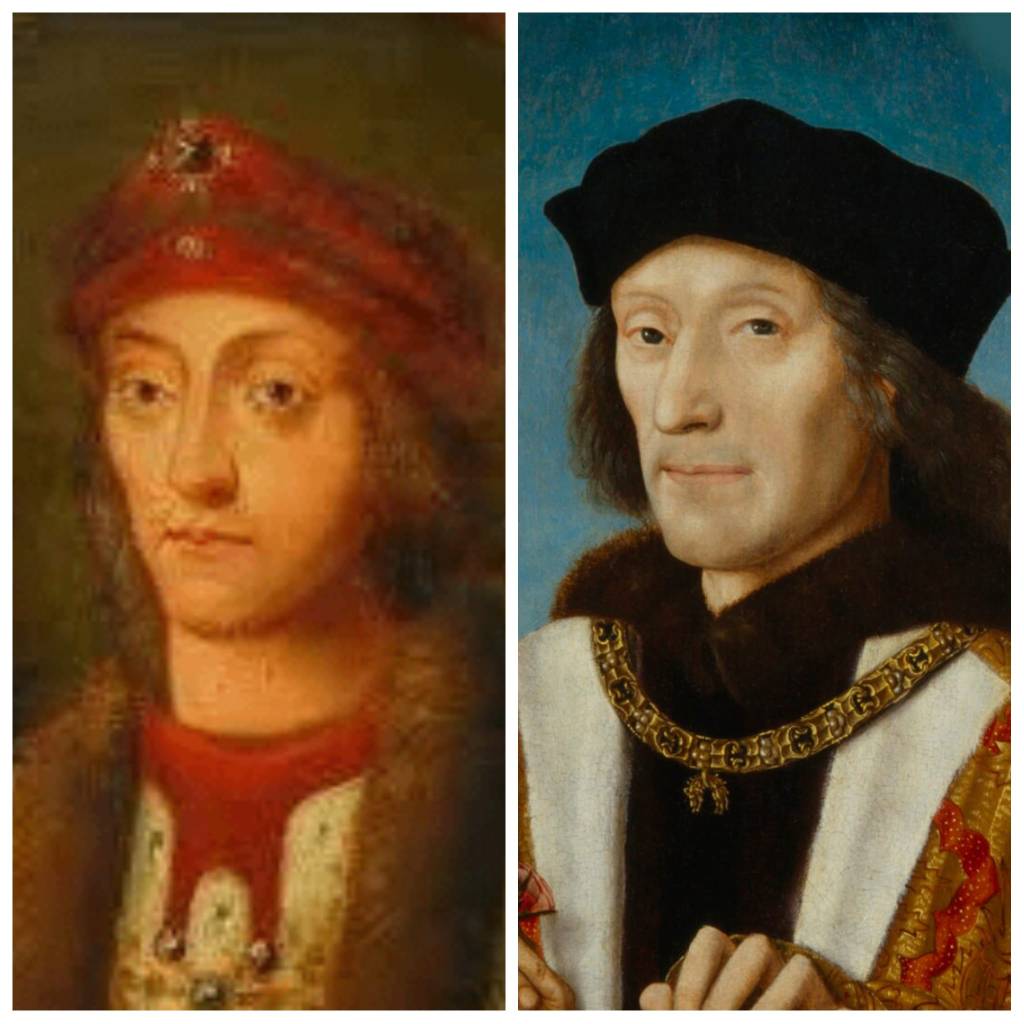
Many place his arrival in England around 1494, but in either case, he was securely established at the royal court by the 1490s.
His first documented appearance was at a joust in honor of young Prince Henry, the future Henry VIII. To take part in a royal joust at such a tender age, without title or noble lineage, was highly unusual.
But de Velville was no ordinary court page.
He lived in the royal apartments at Westminster, and it was truly rare for someone without royal blood to reside there.
He received an annual pension of 40 marks, and spent his days in tournaments, hunting, falconry, and gambling with the king.
His lifestyle was carefree and nearly adolescent. He accumulated no wealth or land, nor did he ever seem interested in climbing the social hierarchy, especially since Henry made sure he didn’t.
Roland lived off his pension, and enjoyed a personal closeness to the king that clearly went beyond mere loyalty.
Unlike other nobles, Roland did not seek power or property. He built no estate, formed no strategic alliances.
It may appear to have been a personal choice, but it was likely dictated by specific rules imposed by the king.
Henry had almost certainly promised him comfort, privilege, and status, but never granted him any title that might have given him cause to demand more than what he already had.
Can you imagine if he had been legitimized?
A legitimized firstborn, a son with claims to France, demanding the throne for himself and plunging everyone back into war between England and France, once again. Who would even dare do that?
One can criticize Henry VII on many grounds, but shortsighted was not one of them.
When Henry VII died, it was Henry VIII who ensured Roland’s future: in 1509, he appointed him Constable of Beaumaris Castle in Wales, a prestigious and well-paid position, second only to the Duke of Suffolk in the region.
Roland was also a respected warrior and public figure.
He fought at the Battle of Spurs (1513) against the French and took part in the famed Field of the Cloth of Gold (1520).
He was present at the funerals of Henry VII (1509) and the Duke of Cornwall (1511).
Curiously, he does not appear to have attended the funeral of Elizabeth of York in 1503. Perhaps as a non-royal offspring, his presence might have been seen as inappropriate?
When Parliament attempted to suspend his pension, it was Henry VIII himself who intervened to safeguard it.
In 1517, Roland was briefly imprisoned for insulting the king’s council, but was released under the single condition: that he remain close to the sovereign.
A telling detail indeed.
The question then becomes: why did Henry VII never openly recognize him as his son?
Roland was born before Henry’s marriage to Elizabeth of York, so his existence would not have triggered scandal.
Previous kings, such as Edward IV and Richard III, didacknowledge illegitimate children.
Henry VII, however, was prudent, reserved, and perhaps eager to be seen as chaste by his people.
But more importantly: legitimizing a child born in France, especially a firstborn, could have caused serious political turmoil once he ascended the throne.
A legitimized Roland would have been in a position to claim the crown, displacing Arthur, Henry, and all the children of Elizabeth, a scenario their mother had already endured.
Such a move might have brought French backing for Roland’s claims, drawing England into yet another war, following the Hundred Years’ War and the Wars of the Roses.
In other words, for a king who aspired to be a peacemaker, this was an outcome he could not afford, and so, he prevented it.
(This also demonstrates that illegitimate children held no power unless formally legitimized.
Note: The Tudor line’s legitimacy stems from Henry VI’s recognition in 1452, which confirmed Edmund Tudor as legitimate. The Beaufort maternal line, although legitimized by Richard II, was excluded from succession by Henry IV.
Without these legal acts, Henry VII would never have gained the support needed to overthrow Richard III at Bosworth. No one fights for an illegitimate claimant.)
Roland also bore a coat of arms similar to that of the Cosquer family, featuring the black boar passant, a noble symbol of Brittany.
Contemporary accounts describe him as tall and fair-skinned, strongly resembling Henry VIII.
The Welsh bards of the era had no doubts. In their verses, Roland was “of royal blood”, a precise, significant expression suggesting legitimate descent.
Even by 1544, nearly ten years after his death, Henry VIII expressed sorrow at the loss of his old Constable, praising his valor and loyalty.
Roland de Velville lived in both light and shadow, perhaps a son of a king who could not, or would not, acknowledge him, in order to protect what he had achieved. A bastard who must not be named, yet was kept in line with rewards, pensions, roles, and glory.
A privileged life carefully managed, not spoiled or publicly honored.
After all, the Tudors were masters at obscuring the truth and shaping it to suit themselves… and Roland was no exception.
Like this? Support my work on Ko-fi and help me tell the stories no one else dares to: https://ko-fi.com/elizabethrasicci
 Beyond Death
Lascia un commento