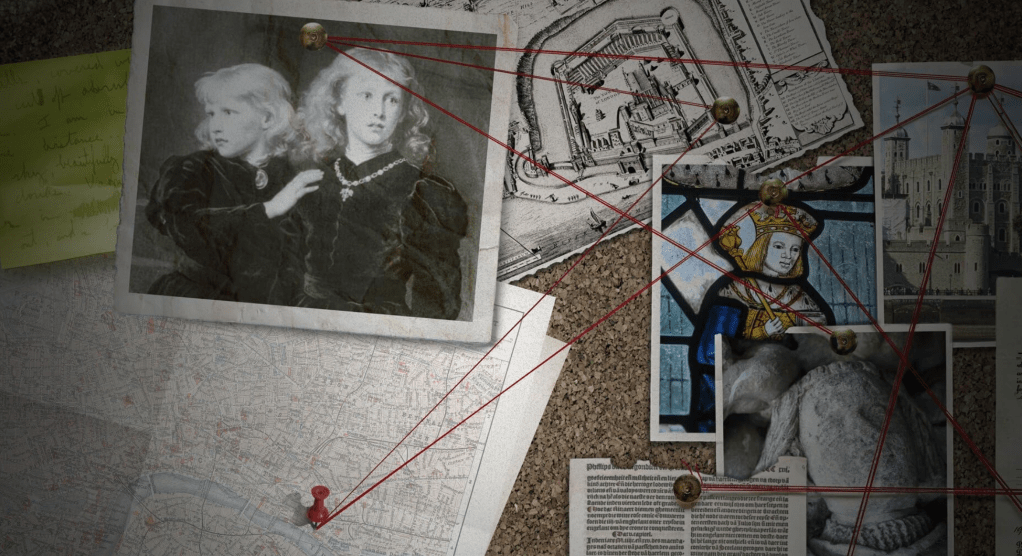
For centuries, it has been taught that Richard III, the last king of the House of York, was the murderer of his nephews. Two children, Edward and Richard, locked in the Tower of London in 1483 and never seen again.
“They disappeared,” they said… but in the history books, the accusation has always been clear: killed by their uncle for the throne.
Okay, and now you’ll ask, “So what’s the problem?”
The problem is that Richard III was accused of killing his nephews, of infanticide, the most monstrous crime imaginable, without ever a SINGLE piece of evidence.
None. Ever.
And yet, an urn in Westminster, containing unidentified human and animal remains, still reads:
“Here lie the relics of Edward V, King of England, and Richard, Duke of York. These brothers being confined in the Tower of London, and there stifled with pillows, were privately and meanly buried, by the order of their perfidious uncle Richard the Usurper; whose bones, long enquired after and wished for, after 191 years in the rubbish of the stairs (those lately leading to the Chapel of the White Tower) were on the 17th day of July 1674, by undoubted proofs discovered, being buried deep in that place. Charles II, a most compassionate prince, pitying their severe fate, ordered these unhappy Princes to be laid amongst the monuments of their predecessors, 1678, in the 30th year of his reign.”
That urn is still on display today and… still today, Richard is named as the culprit (and a usurper!), without a shred of proof. No crumpled scrap of paper.
No direct testimony. No document. Not even a hypothetical sentence that might seriously suggest he killed those children for the crown.
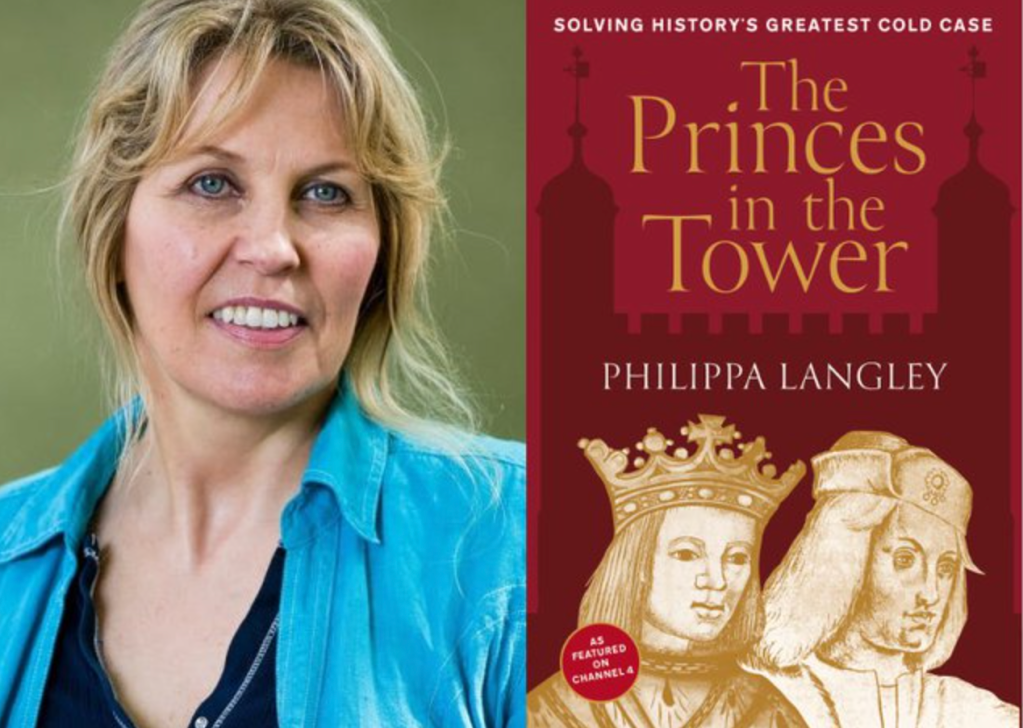
Independent researcher Philippa Langley, already known for finding Richard III’s remains in 2012, has dedicated years to the Missing Princes Project, an investigation conducted with modern methods: archival research, forensic analysis, diplomatic records, and contemporary testimonies.
In her book The Princes in the Tower: How History’s Greatest Cold Case Was Solved and in the Channel 4 documentary aired in 2023, Langley reveals a coherent web of evidence that suggests the princes survived. Not a theory, a hypothesis grounded in tangible material.
I had the pleasure and honour of meeting Philippa Langley in person in 2015, during the filming of my documentary on Richard III, a project that had a difficult, if not impossible, life due to Italian production companies, which are often unwilling to invest in independent work and prefer to fund the usual famous names over emerging authors.
In her, I saw a passion I have rarely found in other researchers.
Because it must be said: there is a huge difference between doing research and being a true researcher in your soul.
The former merely completes the “assignment,” and almost never dares to question their own conclusions (too exhausting, heavens! That would mean reopening files, rereading books, going back to study… oh no!).
The latter, however, feels compelled to do it, because they can’t sleep at night, because they know something isn’t right, because they sense that the truth is very different from the story certain academics keep repeating.
But apparently, it’s not enough… and that’s the reply many traditional historians are giving: Langley’s evidence “isn’t enough,” “it isn’t definitive” to clear Richard.
Fine. And now we reach the core of the matter. Allow me a very simple question: If, with real evidence in hand, you claim that nothing can be said for certain, how on earth have you been claiming with absolute certainty for over five centuries that Richard III murdered them, without even a single piece of evidence?
No proof. Zero. Not a marginal note, not a letter, not a diary.
And yet, for centuries, in textbooks and mainstream narratives, Richard has been cast as the definitive culprit.
At Westminster Abbey, that enormous slab of marble still stands, a public defamation carved in stone, branding Richard as the murderer of his nephews. But on what historical basis?
If what Langley has uncovered isn’t enough to clear his name, then the complete absence of evidence is even less acceptable to accuse him.
So let’s ask the obvious: Why is that plaque still there?
Why has it never been removed, or at least corrected, given the complete lack of historical grounds for such a heavy condemnation?
Perhaps Richard still serves as a convenient scapegoat, a figure to carry the weight of a crime that was never proven.
Perhaps it’s simply easier to keep believing a lie over 500 years old than to admit that the official history, the one taught, celebrated, and carved in stone, got it wrong.
But truth is the daughter of time.
And if today someone brings forward documents, receipts, testimonies, and analysis, and is questioned for doing so, then let’s at least have the intellectual honesty to question the accusation too.
I’m not asking for statues or sainthood. But I am asking for respect for the truth.
And if that truth is complex, nuanced, and still being uncovered, then no one has the right to pretend it’s simple and resolved.
Richard III deserves to be judged by the facts, not by centuries of prejudice.
And we deserve a history that has the courage to apologise when it gets things wrong.
Like this? Support my work on Ko-fi and help me tell the stories no one else dares to: https://ko-fi.com/elizabethrasicci
 Beyond Death
Lascia un commento