
“Eroticism is the approval of life all the way into death.”
Georges Bataille
At the heart of every authentic erotic experience lies a desire that goes far beyond physical pleasure: an ancient, almost religious need for total union, for the dissolution of boundaries between self and other, between flesh and the invisible.
Georges Bataille described eroticism as a liminal experience, that is, one that stands on the threshold, at the boundary between two states (for example between the sacred and the profane, body and spirit, waking and dreaming, life and death).
In this state, the body becomes an instrument of metaphysical inquiry. The orgasm, or la petite mort, as the french call it, is seen by Bataille as a kind of symbolic death, a state in which the human being loses awareness of the self in order to merge with something greater, indefinable, perhaps divine.
“In the act of coitus, man is as if dead, and as if the shadow of death had stamped a smile upon his face.”
L’Érotisme, Georges Bataille
In his thought, eroticism is the realm of transgression, but a sacred transgression: the breaking of a taboo not for the sake of rebellion, but in order to reach an experience of totality.
Pleasure, then, is not escape but revelation. It is not mere instinct, but an opening toward the mystery of death and love.
The body becomes, then, like a temple, and pleasure like a prayer.
Christian mystical tradition, often seemingly at odds with eroticism, actually offers striking analogies. The ecstasies of the saints, from Teresa of Ávila to Catherine of Siena, are narratives filled with deep, intense, and at times explicitly physical sensuality.
In Bernini’s famous depiction of the Ecstasy of Saint Teresa, the angel (Eros) who pierces her with the arrow of divine love symbolizes a union that is both spiritual and carnal.
The saint’s face expresses not only devotion, but rapture.There is no distance between the divine and desire, there is only fusion.
For Bataille, the human being does not merely want to understand God or love,he wants to feel them in the body.
He wants the invisible to become tangible, for the mystery to enter the flesh, for the beloved, or the sacred, to be incorporated. From this arises the desire to unite, literally, with what cannot be possessed.
“Eroticism opens the way to the problem of being.”
L’Érotisme, Georges Bataille
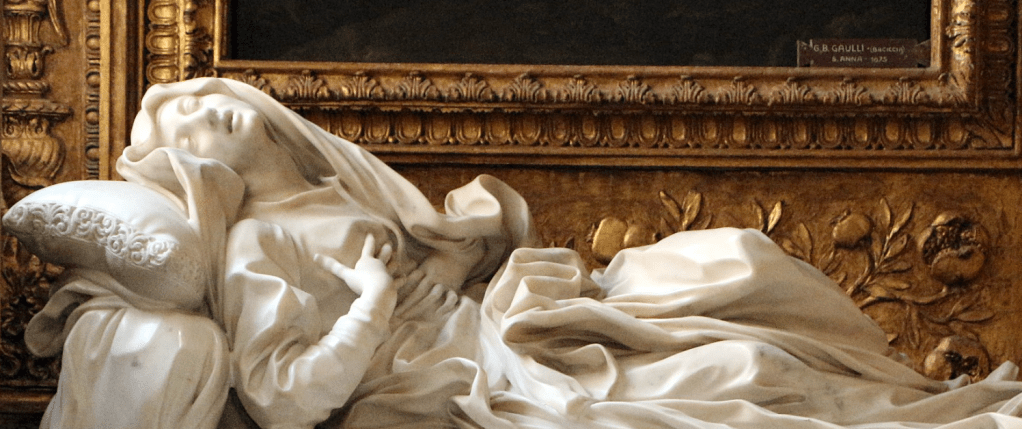
The Ecstasy of Blessed Ludovica Albertoni – Bernini
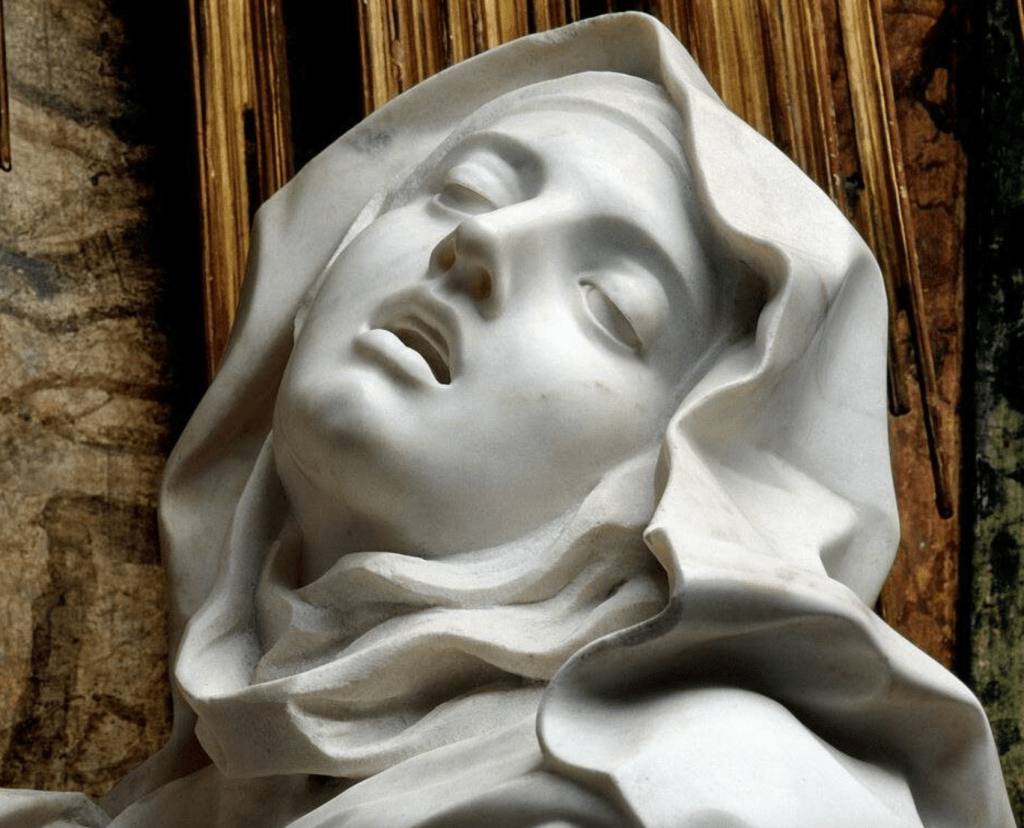
The Ecstasy of Saint Teresa – Bernini
Why is it considered sacred to weep for the dead, but sinful to desire them? Aren’t these two sides of the same love? One we call mourning. The other we fear, we hide. But both are ways of keeping a presence alive. Eroticism is like a ritual.
The Christian Mass, after all, speaks this very language: one eats the body of Christ, drinks his blood.
It is a symbolic act that evokes an ancient memory of sacred cannibalism, but also a deeply erotic gesture: you enter me, I live in you.
Bataille emphasizes that in every primitive religion and the most ancient rituals, life and death are linked through an act of union.
Sacrifice, blood, ecstasy, dance, and eroticism all arise from the same need: to survive separation. To mend the fracture between the human and the infinite.
To desire union with the sacred, to merge with it, is one of the oldest forms of devotion. It is not sacrilege, but an extreme attempt at communion. The boundary between mystical love and eroticism thus becomes thin, sometimes nonexistent.
For Bataille, the true erotic experience is also an act of sovereignty: it does not serve reproduction, nor does it answer to utility.
It is pure expenditure, pure excess. Like sacrifice. Like death.
Eroticism, he says, is the only experience that allows us to accept death while remaining alive, to face it, embrace it, and sublimate it.
In this vision, eroticism is not merely a game of the senses, but a pathway to knowledge.
An ecstasy that defies dogmas and divisions.
A radical, poetic, and bodily gesture to feel that even what cannot be touched may still live in us. In the body. In the flesh. In desire.
Like this? Support my work on Ko-fi and help me tell the stories no one else dares to: https://ko-fi.com/elizabethrasicci

 Beyond Death
Scrivi una risposta a James Elkington Cancella risposta