
I find this article very interesting, and I believe that chart should be included in history books (with some small corrections here and there).
WARNING: LONG POST
What I always find incredible is that Margaret Beaufort’s involvement is never mentioned. Perhaps women don’t kill? Or do they have others kill for them?
Margaret connects all three of the main suspects.
Margaret hated Richard, and her war was as much personal as it was tied to her family’s ambitions.
Margaret was Henry’s mother, and she worked her entire life to put her son on the throne (she believed it was God who had assigned her this task). She had very close ties with Morton and Buckingham.
Indeed, Margaret maintained close ties with Morton and Buckingham during Buckingham’s rebellion. So much so that Richard confiscated her properties and estates, handing everything over to her husband, Thomas Stanley (a bad move, of course).
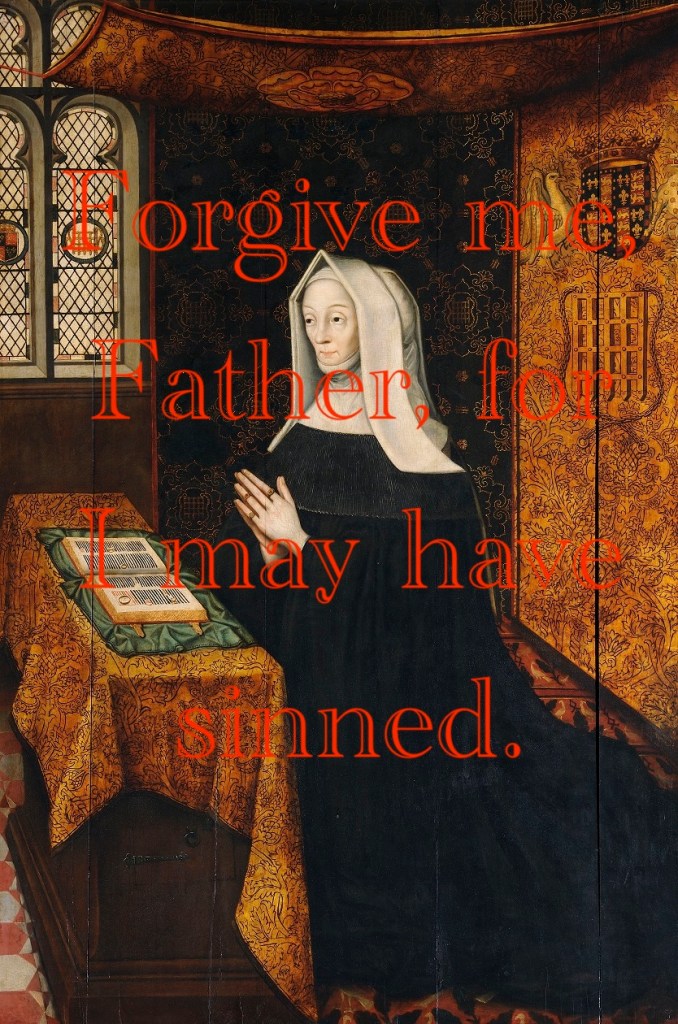
Margaret’s lands and estates were returned to her when her son ascended the throne (what a coincidence!), and Stanley’s life was spared despite siding with the Tudors.
Margaret was effectively the queen, constantly supervising Elizabeth of York. Curiously, there are no surviving letters from Elizabeth, nor from Margaret (except those about rents and trivial matters). Could it really be that the Queen Mother and the Queen never exchanged correspondence? I understand Elizabeth’s situation, as she was under surveillance, but Margaret?
I can easily imagine Margaret burning everything (after all, weren’t the Tudors masters at making things disappear and rewriting facts?).
It’s true that Henry wasn’t in England when the princes disappeared, but… Margaret was. And wasn’t Margaret an extension of Henry? Wasn’t she the mastermind behind everything?
I believe her role is greatly underestimated for many reasons. The main ones are that she was a woman and, above all, a devoutly religious one, making it hard to believe that a mother, a woman, nearly a saint, could murder two children. But… what happened during Buckingham’s rebellion must be seriously considered.
The triangle of Buckingham-Tudor-Morton speaks volumes.
I can imagine Margaret convincing Morton to manipulate Buckingham, who was already dissatisfied. They used him to attempt to kill the princes at a time when Richard and the entire court were occupied with a triumphant entry (there was no one in London but the princes). Meanwhile, Henry would have sailed (and taken London? After all, he had the support of southern men). But… something went wrong. Richard found out, executed Buckingham for treason as a warning, and Henry didn’t land.
And the princes? What would you do if you knew two children had just escaped an assassination attempt? Wouldn’t you protect them somehow? Perhaps… I don’t know… by sending them away?
This might have convinced Elizabeth Woodville to leave Westminster with her daughters. After all, Richard had earned her trust.
I am certain that somewhere, by following Margaret’s trail, we will find something. Perhaps a slip-up by Morton or some other intermediary.
And this might also answer the question: why did Richard never say a word about it? He worked hard to dispel the rumors of a possible relationship with his niece, but he made no effort to clear himself of accusations of double infanticide? In short… either he had serious issues with priorities, or he knew where they were and was protecting them. Just as he protected Elizabeth of York from slanders of incest, because otherwise no one would have married her.
P.S.
I realized I didn’t mention an extremely important figure, without whom, in my opinion, Margaret Beaufort would have been powerless, not just in the matter of the princes, but throughout her life and Henry VII’s rise to the throne: Bishop John Morton.
Morton served under every king, and Richard III was the only one to exile him. Their relationship was hostile from the start, particularly when Morton convinced Edward IV, during his campaign in France, not to fight against Louis XI but instead to accept payment. On that same occasion, they also decided to take custody of Henry Tudor and bring him to England, but it seems the young man was unwell, a cold, poor thing.
Richard kept Morton “imprisoned” at Brecon under Buckingham’s custody, and it was during this period that the two allied and organized the famous rebellion that led to Stafford’s death. When the rebellion failed, Morton fled to Flanders. When Richard tried to secure Tudor’s return from Brittany, it was Morton who sent Christopher Urswick to warn Henry, allowing him to escape to France.
Morton saved Tudor’s life not once, but twice. On the third occasion, luck was on his side: Tudor managed to land in England, kill Richard III, and usurp the throne.
Moreover, I read that in 1485 Morton was in Italy, certainly between January and May. He was likely there to obtain a papal dispensation for the marriage between Henry Tudor and Elizabeth of York, as both were descendants of John of Gaunt.
Morton was one of the most influential men of his time, practically untouchable. To this day, he is remembered as a brilliant statesman. But how thin is the line that separates a statesman from an assassin? And vice versa?
P.P.S. Morton called Margaret “his goddaughter,” and the two collaborated until Morton’s death in 1500.
Like this? Support my work on Ko-fi and help me tell the stories no one else dares to: https://ko-fi.com/elizabethrasicci
 Beyond Death
Lascia un commento